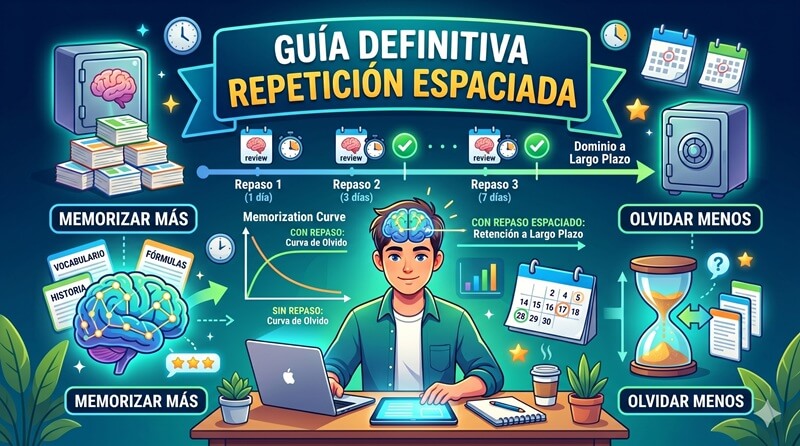
Spaced Repetition: The Definitive Guide to Remembering More and Forgetting Less
Have you ever spent hours reviewing something, felt completely confident that you had it down… and then the next day you could barely remember a thing? If your answer is yes, welcome to the club. It’s not that you have a bad memory. It’s that you’re using the wrong method.
There’s a technique backed by more than 130 years of scientific research that can completely transform the way you learn. It’s called spaced repetition, and once you discover it, you’ll never study the same way again.
The Problem We All Share: We Forget Too Quickly
Picture this: you attend a class, you take notes, you reread the topic that same night. All good. However, a week later you can barely remember 20–30% of what you studied. Sound familiar?
It’s not your fault. It’s simply how the human brain works.
In 1885, the German psychologist Hermann Ebbinghaus became the first scientist to study memory systematically. His method was unusual: he used himself as the experimental subject, memorizing lists of meaningless syllables and measuring precisely how long it took him to forget them.
What he discovered was eye-opening: memory doesn’t decay in a linear way, but exponentially. He named this phenomenon the forgetting curve.
Ebbinghaus’s Forgetting Curve
Ebbinghaus’s central finding is devastating:
- 20 minutes after learning something, you’ll have already forgotten around 40%
- 1 hour later, you’ll have lost approximately 56%
- 24 hours later, forgetting hovers around 70%
- 1 week later, barely 25% retention remains
- 1 month later, the information will have nearly evaporated entirely if you didn’t review it
In other words: if you only study once and never touch the topic again, you’re throwing most of your effort out the window. Hours of study that vanish while you sleep.
The good news is that Ebbinghaus also discovered the antidote.
The Spacing Effect: Why Reviewing at the Exact Right Moment Changes Everything
Ebbinghaus observed that every time you refresh a memory just before it disappears, the forgetting curve “resets” and, on top of that, the memory lasts longer. You don’t just avoid forgetting — the next interval before forgetting becomes longer.
This is the spacing effect: distributing reviews over time is far more efficient than piling them into a single session (what we know as “massed study” or cramming).
Picture it like this:
- Massed study: You study 5 hours in one day → You remember well the next day → You forget quickly
- Spaced repetition: You study 30 min today → Review 10 min tomorrow → Review 5 min in a week → You remember months later
The result? With less total time, you achieve much greater and longer-lasting retention.
This has a neurological explanation: when we actively retrieve a memory (instead of simply rereading it), the brain interprets that information as “important” and strengthens the neural connection. It’s like a road — the more you travel down it, the wider and more solid it becomes.
The Leitner System: Spaced Repetition Made Physical
In the 1970s, the German journalist Sebastian Leitner brought Ebbinghaus’s principle into everyday practice with an elegant and simple system: the box system.
The idea is brilliant in its simplicity:
- You have several numbered boxes (usually 5): box 1 is reviewed every day, box 2 every 2 days, box 3 every week, and so on.
- You start with all flashcards in box 1.
- If you answer a card correctly, it moves up to the next box (reviewed less often).
- If you get it wrong, the card goes back to box 1 (needs more frequent review).
With this system, you spend more time on what you don’t know and less time on what you’ve already mastered. No more reviewing what you’ve already internalized.
The Leitner system was revolutionary for its time and remains the conceptual foundation of many modern flashcard apps. The difference today is that you no longer need physical boxes or have to keep track yourself.
Why Traditional Studying Fails (and What Spaced Repetition Does Differently)
You’ve probably been taught to study like this:
- Read the topic several times
- Highlight what’s important
- Write a summary
- Review the day before the exam
This method has a name in cognitive psychology: passive learning. And it has a fundamental flaw: the illusion of learning.
When you reread something you already know, it feels familiar, and that creates a sense of mastery. But familiarity is not the same as recall. On exam day, when you try to retrieve that information from scratch, you realize it’s not really stored.
Spaced repetition works in the completely opposite way, based on active recall: instead of reading the answer, you force yourself to search for it in your memory before revealing it. That retrieval effort, although uncomfortable, is exactly what consolidates learning.
The science is clear on this: several studies have shown that the testing effect — practicing retrieving information instead of simply rereading it — can improve long-term retention by up to 50–70% compared to equivalent passive study.
How to Apply Spaced Repetition in Practice
Now that you understand the theory, let’s see how to put it into practice effectively.
1. Use Flashcards (but well-made ones)
Flashcards are the ideal format for spaced repetition because they force you to retrieve actively. The key is to make them correctly:
- One idea per card. Don’t cram five concepts onto a single card.
- Specific question, concrete answer. Instead of “What is photosynthesis?”, ask “What are the two final products of photosynthesis?”
- Use your own words. Cards copied word-for-word from the textbook are less effective.
- Add context or an image whenever possible to create more mental anchors.
2. Respect the Intervals
The temptation is to review everything the same day. Resist that temptation. The power of spaced repetition comes precisely from letting time pass between reviews. If you review too soon, you’re not exercising the memory muscle.
3. Be Honest in Your Self-Assessment
When you review a card, honestly evaluate whether you knew it or not. If you hesitated a lot, even if you gave the right answer, you may need to keep reviewing it soon.
4. Short and Frequent Sessions
Instead of marathon sessions, spaced repetition works better with 10–20 minute sessions spread across multiple days. Studying 15 minutes a day for a week easily beats studying 2 hours in a single day.
5. Start as Early as Possible
The forgetting curve is steepest in the first few days. If you start applying spaced repetition from the very first day you study a topic (not the week before the exam), the effect is exponentially greater.
Spaced Repetition in the Digital World: From Physical Boxes to Algorithms
The Leitner system was great for the 1970s. But managing dozens or hundreds of physical cards, remembering which box each one is in, and calculating when each group needs reviewing… is a job in itself.
This is where technology changed everything.
In the late 1980s, the Polish computer scientist Piotr Woźniak developed SuperMemo, the first software that automatically calculated the optimal review moment for each individual card, using what he called the SM-2 algorithm. Instead of boxes, every card had its own personalized schedule based on your answer history.
This was the seed of what we know today as spaced repetition algorithms, and the foundation on which Anki (the reference app for years) and all modern flashcard apps were built.
Today, algorithms go well beyond the original SM-2. The best apps incorporate:
- Individualized intervals per card and per user
- Difficulty analysis to adjust review frequency
- Retention prediction for each card at any future point in time
- Dynamic adjustment based on your real performance in each session
The result: the system does all the organizational work for you. You just have to show up and answer.
Spaced Repetition + AI: The Next Evolutionary Leap
If the digitalization of spaced repetition was a major leap, the integration of artificial intelligence has opened up a new dimension.
The historical bottleneck was always the same: creating flashcards takes a lot of time. Converting 50 pages of notes into well-made cards could take hours — time that many students simply don’t have.
Generative AI has eliminated that problem. Today you can:
- Upload a PDF or paste your notes and get a deck of flashcards ready to study in seconds
- Generate multiple-choice questions automatically from any material
- Get tailored explanations when you don’t understand an answer
- Create content in any language with no extra effort
This means the only work left for you is the work that matters: studying and learning. The rest is handled by the technology.
Deqsy: Spaced Repetition with AI, No Manual Setup
If you’re looking for an app that combines spaced repetition, generative AI, and ease of use — without having to become an expert in configurations — Deqsy is exactly what you need.
Deqsy is a flashcard app designed from the ground up for the modern student. Here’s what makes it different:
🧠 Automatic AI Generation
Upload your PDFs, paste your notes, or even process the audio of a class. Deqsy’s AI (powered by Claude 3.5 Sonnet, one of the most capable models on the market) generates flashcard decks and multiple-choice tests in a matter of seconds. What used to take you hours now takes minutes.
⏱️ Automatic Spaced Repetition Algorithm
Forget about boxes or calculating when to review each card. Deqsy manages the intervals for you, making sure you review every concept at the exact moment when you’re about to forget it.
🛒 Deck Marketplace
Are you studying for civil service exams, medicine, languages, or any popular subject? Chances are other students have already created the deck you need. The Deqsy marketplace lets you find, rate, and download community decks so you can start studying right away.
📊 Exam Mode and Multiple Choice
Beyond classic flashcards, Deqsy includes an exam mode with multiple-choice questions to simulate real test conditions. Ideal for civil service candidates and university students.
🌍 Multilingual
Study or create decks in whatever language you need. Deqsy’s AI works in any language, making it perfect for learning foreign-language vocabulary or studying syllabi in other languages.
If you’ve been studying with the traditional method up to now — rereading notes, highlighting, and praying you’ll remember it on exam day — it’s time to make the switch.
Spaced repetition, combined with AI, is not magic. It’s science. And Deqsy puts it within reach of any student, with no complicated configurations or hours of preparation required.
Conclusion: What Separates Those Who Remember from Those Who Forget
Hermann Ebbinghaus identified the problem more than 130 years ago: we forget naturally and quickly if we don’t review at key moments. Sebastian Leitner found the practical solution in the 1970s. And modern technology has made it accessible, automatic, and AI-powered.
Spaced repetition is not a trend. It’s one of the best-documented phenomena in the psychology of learning, backed by decades of studies.
What has changed is that now you have no excuse not to apply it.
You don’t need physical boxes. You don’t need to calculate intervals. You don’t need to spend hours creating flashcards. You just need the right tool.
Try Deqsy for free and discover what it really means to memorize for the long haul — not just for the exam.